The real Konservative Revolution
The Brabantine Revolution of 1789 doesn’t attract much attention in general discourse for understandable reasons. Epochal events were underway not far south of modern Belgium in that most auspicious of years. It has however attracted the comment and analysis of some fine masters of history, such as Jacques Godechot(pioneer of ‘Atlantic history’), EH Kossmann(the premier Conservative Dutch historian) and Henri Pirenne(A Belgian national liberal more famous for his Mohammed & Charlemagne thesis). Taking the lead from another giant of the field, François Furet, any investigation has to also account for subsequent historiography. Aside from comparisons to the Dutch Revolt and it’s role in the formation of a Belgian identity, it is the question of it’s relation to the seismic events in France which is pivotal for discernment of the true character of the revolution.
The distinct culture of the region that became modern Belgium came from it’s Catholicism in opposition to the Northern Provinces which had broken free from Habsburg rule. The region which we call the Spanish Netherlands was known to the Castillians simply as Flandes, after it’s most prosperous constituent. It was even sovereign and prosperous for a period under Isabella Clara and Albert of Austria, albeit with Spanish military support. It passed to the Austrian Habsburgs as a moth-eaten non-contiguous territory after the War of the Spanish Succession as Louis XIV annexed Lille and Dunkirk, leaving Flanders and Brabant on one side seperated from Luxembourg by the independent Prince-Bishopric of Liège, the story of which will tie in to the main topic discussed later. The complexity of the region was exemplified by the condominium of the Prince-Bishop and the rulers of Brabant over the city of Maastricht. Besides economic output, Flanders was also a centre of culture, producing Rubens and Van Dyck and was also home to the University of Leuven, an important theological and legal school which taught Erasmus and Bellarmine. Highlighting it’s closeness to France, Leuven was also ground zero for the Jansenist movement, it’s founder Cornelius Jansen learned and taught there too. Another movement popular at the institution was Neo-Stoicism, pioneered by Fleming Justus Lipsius who may be familiar to those who have read Gerhard Oestereich on the state and military reforms of the Netherlands Movement attributed to the influence of Lipsius. In the 18th century, the Austrians also tried their hand at chartered overseas trading with the Ostend Company headquartered in the Flemish port and gave stiff competition to the British East Company in the Chinese tea trade for the two decades it existed.
I have pointed out before Paul Bois’s study on the Revolutionary support in Anjou-Touraine being stronger among wealthier free peasants east of the Loire than tenanted peasants on the west, which became a bastion of Chouannerie. Furet brought forth another example comparing the region as a whole with it’s larger share of clerical property dissolved for the biens nationaux and share of refractory clergy whereas bastions of Revolution and later Republicanism in the South-West had less clerical influence and more juror priests who took the Oath. Louis Chatellier’s excellent work on the sodalities/compagnes and their growth spurred by Counter-Reformatory missions by Orders to re-evangelise to urban and country denizens also gives us another clue about the religious causes which galvanised the Brabançonnes as it did the Chouannerie. When one reads about religious processions with crucifixes and saintly images being used as a political signal protesting Josephinism, one can naturally draw a line to communal practice of devotions popularised in Flandes in the previous centuries, which had not persisted in France save in regions like the Vendeé. The precipitous decline of sodality membership in France is documented in detail by Chatellier, as indeed there was cultural revulsion at these superstitious practices expressed by Pascal and Moliere’s Tartuffe, political opposition to Jesuits especially from the Parisian Parlement and the ever-expanding French Crown. The decline of religiosity in Provence documented by Michel Vovelle through study of public documents lends an insight into this. Irreligiosity and fertility decline by region also correlated with the imposing taille tax that facilitated the centralisation at the behest of the aforementioned French Crown. Dale Van Kley speaks of the nature of Jansenist practice and emphasis on the private experience of the Dieu d’Abraham and the possibility of a slow reaction to outward displays of faith which rescinded to private faith or abandonment altogether. Based on some Provençal wills which speak of the ‘Divine spirit’ or indeed the Supreme Being, one can say that the new Divinities of the Revolution were already a reality two decades before Robespierre. This was not, however, the case in the “Austrian Netherlands”. Chatellier points out that where the dévots declined in France, that in Italy, Alsace and yes Flanders, the firm establishment of Jesuit presence enabled a Social Catholicism to develop which appealed to wide range of social groups. As an example, Flanders was home to a Religious Company for cloth makers, naturally, but also home to a society for married men, the Society of the Annunciation which focused on viewing the sacrament as a vocation as was there one for young unmarried men, that of the Nativity.
We can safely speak of twin factors in the cause of this most Happy Revolution, one that saw collaboration between the progressive middle classes generally clustered in Flanders and the aristocratic and lower classes mostly concentrated in Brabant against the policies of the Emperor Joseph. The Emperor had recognised the need to establish himself and his realm as Teutonic first and foremost, having attempted to annex Bavaria upon the extinction of the main Wittelsbach line in 1777 to consolidate his power in Germany proper, only to be blocked by his mother’s rival and equally keen Enlightened despot, Frederick the Great, whose support of Karl VI of Bavaria as Kaiser as a break from the inheritance of the Habsburgs in 1742 was probably the source of Joseph’s anxieties. In fairness to the man, he had been willing to exchange Bavaria for his Netherlands possessions as pawn to the Count-Palatine of the Wittelsbach cadet branch, who himself was not opposed to acquiring these territories, but Alte Fritz formed a Fürstenbund to block this transaction and marched into Bohemia. Rather ironic considering the veneration of Frederick that here it was his opposite number wanting to formally Germanise the complex Holy Roman structure whereas Frederick became a defender of the subtle balance. The Emperor then focused on his ambitions marked foremost by concern about synchronisation and efficiency among his disparate domains. Joseph’s policies of Germanisation of administration naturally led to protests among his Hungarian and Netherlandish subjects. The rise in Flemish national consciousness through intellectuals distinguishing and recognising the Taal, itself an Enlightened development provoked the disapproval of the conscious Flemish bourgeois whereas it was the revocation of the ancient Joyeuse Entry of 1356(the traditional bill of rights) which sparked most anger in inland Brabant. It was the purpose of the representative community of the Land, the Council of Brabant, to ensure that no sovereign contravened the terms laid out in the Entry and it’s preceding binding document, the Charter of Kortenberg, which emphasised the right to resist by all orders against the sovereign who dared to take such action. Much in this bill can be said to be “Liberal” for a document this old, if one is inclined to use this anachronistic label. This constitutive order had held through rule by Bohemian, Valois, Spanish and Austrian Habsburg rulers before Joseph took precisely this measure. The Emperior wished to replace administrative structure with a single Regeringsraad overseen by a minister-plenipotentiary appointed by him personally. Joseph also further angered the trade guilds, revoking their privileges and tariffs on the grain trade, thus imitating Turgot, which caused an economic slump forcing him to revoke these measures. There was also first the Patent, then the Edict of Tolerance issued by the Emperor for Lutheran and Orthodox subjects of the Habsburg domains, with the Edict confirming it’s extension to the Jewish population as well. This piqued his staunchly Catholic subjects in the Austrian Netherlands. The Emperor in Vienna had managed to anger just about everyone concerned.
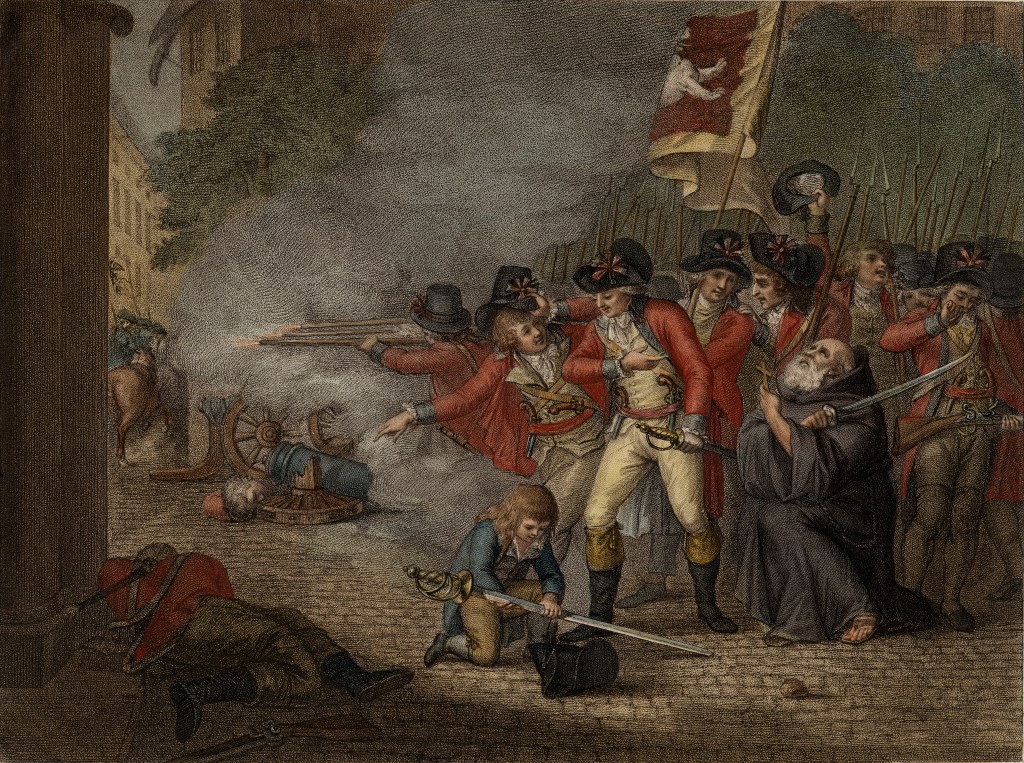
There had been a wave of riots and disruption in 1787, termed now as the Small Revolution. The representative lawyer employed by the Estate to defend it’s traditional bill of rights, Henri Van der Noot, to argue on it’s behalf, was spurred by Joseph’s reticence into becoming a man of action. In 1789, Van der Noot crossed into the Austrian possessions from Breda in the Netherlands with a small force which won a stunning victory against a larger Austrian army at Turnhout. This was preceded by visits to Great Britain, Prussia and the Netherlands to appeal for support. In Hoogstraten, the leader issued his public manifesto for the people of Brabant. Worth noting that the manifesto was very much influenced by the American Declaration of Independence. The victory enabled him to capture Ghent and proclaim the Republic. One of the authors of the new Belgian constitutions was Henri-Jacques Le Grelle, of the Le Grelle family of note(later among the great financiers of the Papacy), symbolising the assent of the local aristocracy. These Patriots forced the Austrians to retreat to the secure fortress of Luxembourg. Next door, Liège overthrew it’s old-fashioned Prince-Bishop César de Hoensbroeck in support of the reforms carried out by it’s previous Bishop, Charles-François Velbruck. The contrast could not be sharper. The two factions which emerged after the establishment of the Republic, led by Jan Frans Vonck and Van der Noot, fell out in a manner reminiscent to what some in living memory happened in Iran following the ’78 revolution. It worth mentioning Jan-Baptist Verlooy, a partisan of Vonck, the author of a protest written to Emperor Joseph to defend the right of the Netherlandish language, arguably establishing him as a precursor to the Flemish Movement. Although, in this period, the sharp polar divide on linguistic lines which has characterised Belgian politics since the inception of the nation was not evident and the threat here was not welfare-sucking Walloon vampires of the sillon industrielle but Standard German.
In reverse of the radicalisation in France, the Aristocraten faction of Van der Noot succeeded in enlisting the support of the Patriotic organisations and also of the rural population which marched in great numbers to Brussels with crucifixes and saintly images, expelling the partisans of Vonck from the General Assembly. What failed to materialise was the foreign support of Prussia as desired by Van der Noot. The Brunswick manifesto and the Declaration at Pillnitz bringing Prussian troops to the vicinity were to come later. After ascending the Imperial throne and concluding peace with the Ottomans in a war supporting the Serbian Free Corps, Leopold restored Habsburg control over the possessions and took out the Liegoise at the same time in late 1790, defeating the Aristocraten army at Falmagne. However there was no respite for the region as the French Revolutionary Army of the North entered the region in 1792, achieving the annexation of the region into France with the victory at Fleurus in 1794. Originally led by the constitutional monarchist Dumouriez, he brought with him members of the Comité des Belges made up of exiled Vonckists and Liegoise. There was a general sense of cheer in French-speaking and more “French Revolutionary-aligned” Liège whereas the Flemish towns were more reserved in their reaction. The Army of the North kept many wealthy Flemish notables as hostages to contribute to the war effort, no doubt creating more animosity. Dumouriez’s defection to the Austrians accompanied by a young Louis Philippe, later the July Monarch, owing to Revolutionary excesses and the perceived incompetence of the Committee in Paris set in motion a series of cascading events back home. The general’s Girondin sympathies meant that Philippe Egalite and many a former compatriots saw their heads roll for this, ultimately leading to the ascent of the Mountain. I do wonder, as a side note, if elements of the Montagnards took inspiration from the sodalities? Robespierre praised and implemented those very aspects of Catholicity that the missions had encouraged among the population, now to be used to reconstruct a civic religion. The fervent mysticism of Catherine Theot, Suzanne Labrousse and Dom Gerle(who had in 1790 called to make Catholicism the official religion of the New nation of the Third Estate) and the apogee represented by Talma and David’s organisation of the Festival and the supplanting of the more abstract Cult of Reason could lead one to such a conclusion. But perhaps more for another time.
Contrary to those wanting to concoct grand analogies with superficial similitude, the truth of the matter is that Emperor Joseph was a committed Enlightenment despot as was his brother, successor and father of Antoinette, Leopold. As was in some sense Antoinette’s spouse, Louis XVI. Leopold as Grand Duke of Tuscany had implemented sweeping reforms regarding capital punishment as advised by Cesare Beccaria and had sought to combine executive powers with legislative powers in a new Tuscan Constitution. He also convened the Synod of Pistoia which sought to reorganise the Catholic Church in Tuscany along Gallican lines, supported by bishops of Jansenist tendencies mirroring the support Jansenist remnants led by the Abbè Gregoire gave to the Civil Oath in 1791 or the example of Bishop Andrea Serrao of Potenza who supported the French-installed Parthenopaen Republic in Naples. It was the Sanfedisti who rose up across Italy after the overthrow of the Neapolitan republic who reversed the capital punishment statues in Tuscany for a short period before the Napoleonic annexation of the region into France proper and the application of the Code. The Bavaria of Montgelas was a natural ally to Napoleon for this reason all the same. Also, as Ronald Axtmann laid out, Austria was already a true Polizeistaat, employing Imperial dragoons as a permanent watch militia, drawing a parallel in the terminological development of policy and police in the Austrian as conceptual twins far before FJ.Stahl’s comparison of it to his desired Rechtstaat. Hardly the epitome of the Conservative-Patrimonialist bogeyman. Enlightened despotism balked at it’s own philosophical creation in the hands of the rabble just as Tocqueville was correct in laying blame for the erosion of the ancien regime in France at the feet of the French monarchy itself.
This ought to dispel myths and tropes of historiography. A rising national consciousness did not find opposition from the Aristocraten in Brabant. Rather, their supporters could assert that the Brabant Estate was the Nation in opposition to an Enlightenment despot’s ambitious plans for Germanisation. This attempt to replace provincial governance with an intendant plenitpotentiary, a venal professional role serves as a perfect example of the harmful effects of Absolutism which accentuated the Dualism of King and Estate. It was the Conservative Van Der Noot in his manifesto who spoke of the “Will of the Nation”. The United Belgian States was also a Republic, appealing to Flemish rights of old, unmoored by dynastic loyalties unlike the Monarchophilia of later Conservateurs owing to polemological neccesity of opposing the Revolutionary excesses, thus not in reaction to it. Friedrich von Gentz was correct in seeing the American Revolution as a manifestation of the same tendency. It also thoroughly reinforces the Kondylis rebuttal on the queiscence and passiveness of the Conservative nature and situates a real historical confrontational Conservatism which has barely any resemblance to the present political tendency which shares it’s name.


 The Mystagogue's Blog
Leave a comment