“On this account I, or rather the Lord, beseech you as Christ’s heralds to publish this everywhere and to persuade all people, whatever their rank, to carry aid promptly to those Christians and banish that vile race from the lands of our friends…Let therefore hatred depart from you, let quarrels end, let wars cease and let all dissensions and controversies slumber”- Pope Urban II at Clermont, as per Fulcher of Chartres
<
I write this against the ability of present popular imagination, to comprehend a wholly different hierarchy of values and also equally the assertion that the bellicosity and spirit of Old Europe may be wholly attributed to simple biological conflict and desire to impose one’s will, which is more intellectually nuanced than the former in recognising a constant of the human condition, but lacks explanative power nonetheless. Further, the issue is not only the basis of interpretation, but what is inferred from the general account of these times. What I am crusading against is the simplistic abstraction of categories from their historical frame in favour of metahistorical contextualisation.
What better place to start such an investigation than the source of Christian teaching? Looking into the words of the prophets such as Isaiah, Hosea and Amos, God is an active mover of history itself, directing the fate of and judging all nations as per his well. The Hebrew half of the Bible is evidently a self-contained world defined by the laws of a vital, judgemental God. The sins and appropriate judgement of all nations are listed, the grand narrative fits eloquently within the view of an manifested hand of Providence, delivering penitential justice through Divine Command. And this judgement finds it’s lineal conclusion parallel in Apocalypse where the Kings of all nations, redeemed, will walk by the light in New Jerusalem before a revealed God. Mircea Eliade rightly noted in Hebrew religious development the idea of a coefficient of irreversibility, borne from a new form of theophany not concerned about the circulation of sacred energy, but a diaphanous historical plan of salvation. But even for the perceived quiescence of the New Testament Gospel narrative of Incarnation, it should be noted that passages such as Luke 22:261 and John 15:132, and the important commandment to love one’s neighbour have also provided many a commentators with an understanding of good rulership and the defensive necessity as an expression of Christian love towards that which one naturally feels inclined to love, the narrative drawing it’s close with the Passion, a full sacrifice itself. It would surprise some, keen to infer that the marching Latins were guided by little Christian sensibility, to read Urban’s speech at Clermont, or at least Robert the Monk and Fulchers’3 account of it and find many appeals to the selflessness of Christ or the Christly ethos4 or that the first half of the speech was explicitly to establish a Roman law justification for the liberation of the East.
Among Church Fathers, Tertullian, though over time began to identify with the pacifistic and spiritualist Montanists of Phrygia, had on an earlier occasion enunciated the first recorded difference between Christian belief and Indian religious philosophy when he noted that compared to the Brahmin and Buddhist Gymnosophoi who escaped to the forests, Christians prayed for “the imperial house, the Legions, for a faithful senate and a virtuous people”5. Here the skilled apologist makes a clear reference to 1 Timothy 2, where in fact the faith advises one to pray for Caesar. Tertullian had also recounted the embellished story of a Christian Legio XII Fulminata6 in saving the Empire’s honour with great pride, which may have had ground in reality, Fulminata did camp regularly in Melitene in Cappadocia, a major early Christian centre. And yet, for the Latin Father, to stay one’s hand was the dutiful Christian thing to do. But the truth is that the Constantinian shift rendered any previous debate in the period of formalisation of structure null. Canon III of the Synod of Arles(314AD), which includes the proscription, “those who throw down their arms in times of peace are to be ostracised from the community7” may be indicative of this immediate shift. Christianity was now the preferred faith of the world’s most powerful empire. We see this in Lactantius. In the Divine Institutes, he squarely states, “killing a human being whom God will to be inviolable is always wrong”8. But in the Epitome, considered by most a later work addressed to the catechumen Pentadius as a summary, Lactantius has seemingly turned face and sees the necessity of the passions which animate war, going so far as to say that to fight for one’s patria is a good and to fight against it a vice9. I posit, though in no way am I saying it first, that for Constantine to have issued the Edict of Milan with Licinius, there must have been a substantial Christian presence, no even more so, influence in the loyal Western barrack outposts of Trevorum(Trier) and Eboracum(York), even if this was in Frumentarii or Auxilla formations of the Legions.
Western Christian notions of Holy War were refined with theoretical justification by St.Augustine and his patristic successors. A vital point to make in addition is that the Latin translation of St.Jerome, the Vulgate, which became the standard text of the Latin Church translated the word enemy as “inimicus”, not hostis, and so that there was no intrinsic contradiction in personal forgiveness and measures such as public violence to ensure security. But Augustinian sources were indispensable in the accumulation of Western canon law, providing quotations for the medieval canonical compilations such as the Panormia of St.Ivo of Chartres, the Collectio Canonum of St.Anselm of Lucca or the Decretum of Burchard of Worms. Ivo’s Panormia reproduced near complete passages from Augustine’s letters, such as that to Publicola, which proscribes killing except as a “miles aut publica functione”[as a solider or civil servant]10. The great Latin Doctor was certainly not insensitive to the question of violence, identifying the “lust for power” 11as the great evil of war, but accepting the legal basics of the Roman notion of just war as a legitimate course of action for the maintenance of peace and for self-defence. Augustine would write that a just war could be initiated in obedience to God or by lawful authority, that in fact Divine Power accords the sword to an earthly power for a good reason. St.Anselm relied in particular upon the anti-Donatist writings of Augustine in order to argue that righteous wars could be fought not only with an intent to punish sinners or not solely for the sake of justice but also out of charity. Letter 93 to Vincentius does contain an appeal to charity and duty to compel by force, if necessary(“Whomsoever ye shall find, compel them to come in.”12). Augustine noted how the fear of the edicts alone and not his previous idea of utilising the force of reason to coerce had brought people back into the Catholic fold in his own city of Hippo from the Donatist churches, quoting Proverbs 29, “happy is the one who keeps the Law…where a servant of hardened heart understands but cannot be corrected by mere words”. Discussing God’s mission to Moses, Augustine wrote the proscription, “Sed his exceptis quos Deus occidi iubet sive data lege sive ad personam pro tempore expressa iussione.(To not kill save when God commands, either by a given law or a personal command)13. By the time he was writing the City of God, Augustine was watching his beloved Rome lose her provinces to barbarian warlords and gleaned from his beloved Paul the innate unattainability of peace through human action owing to the depravity of the human state. So violence is recast as an obscure mechanism, to it’s mystical providentialism as it was seen by the Hebrews of old, by which the harmony of Creation was preserved. St.Isidore of Seville followed in this vein and asserted that there can be no just war without justice as an end and part of his mythographic construction of a universal history also entailed glorifying the events in Gothic history in the Chronicles(Greater and Lesser)of the Spanish saint. Here great battles and conflicts are imperative in the cosmic drama which sees the availing of a new chosen people, namely the Goths who become Spaniards. St.Ivo also, writing around the First Crusade, insisted that even killing committed in holy war required contrition and penitential sacrifice. And yet this sat comfortably beside his justification for force and also the view that military prowess and glory were a direct gift from God. But I do not mean to portray this as a settled question in Christian thinking. We have the popular story of the renunciation of the military life by St.Martin of Tours to found the monastery of Marmoutier inspiring medieval themes of renunciation all the same. And he was certainly a man to whose legacy Emperors and Kings paid homage.
10th century France was a very violent society. The rise of the semi-independent allodial Castellans had come about as a response to the great raids conducted by Danish Vikings and even adventurous bands of Magyars into West Francia. Arguably, the power of the grand magnates had first been recognised by the Merovingian King, Clothar with the Edict of Paris(614). However, these rights and privileges had been confirmed by Clothar to allow local seneschals to enforce judicial norms and to acknowledge his gratitude for siding with him against the nefarious Brunhilda. This is believed to have been the first general acknowledgement of the powers of the magnates of the realm in Frankish history. All in the name of felicitas regni. But there was certainly no felicitas in the 900’s in Francia Occidentalis . Fragmentation of Carolingian central authority was marked by a series of jostling kingships between the last Carolingers, Bivinids and the Robertian-Capetians, further compounded by the petty interests of the Carolingian branch of Vermandois, the counts of Flanders, the ascendant House of Blois and later the emerging Norman Count-Dukes, leaving Northern France a patchwork of competing lordships. A surprisingly popular movement arose in response to the wanton violence, that of the Peace of God. In 989, at the Benedictine Abbey of La Charroux, a great crowd gathered, bringing from Limoges and Poitiers bodies of saints demanding religious proclamations of immunity(emunitas) for it’s entire patrimony, eventually granted by the Abbey to all churches and peasantry under their protection and signed by local bishops in the absence of the authority of Hugh Capet, who only nominally controlled Neustria(the French heartland). Over time the protections would be extended to women, children and travelling merchants14. The founding of powerful abbeys such as Cluny and Fleury was in parallel to the phenomenon of a new energetic building of parish churches in villages across France, Northern Italy and the Rhineland at the beginning of the 11th century. In time, the greater lords also found it to their advantage to consolidate smaller feuding lords and establish retinues that regulated warfare.
Following a territorialist line of thinking about the influence of Gallo-Roman provincial law on Merovingian legislation, we have the commendatio(and related fideicommissium)of the Late Roman Empire, or even the subfeudatory notion of the beneficium being utilised by monarchs. Relations of subvassalage were generated thus. A beneficium was also synonymously called a ministerium. In a Charlemagne’s time, a comitus or grafio(in Old Franconian) was only entitled to collect penal fines, representing the ephemeral nature of these delegations at that time. The Truce of God became a vehicle for feudalisation, which does not mean as commonly understood, the sum of all dependencies, in fact, it characterises the idea of a provision of services from the land which was not found prior in the allodial system which was a more pure system of manorial independence. Hence the former purely interpersonal relations of the Gallo-Roman Bucellarii or the Frankish leudes were legalised through the bond of loyalty and the extension of the royal privilege of immunity as a mark of delimitation of the sphere of authority subject to a King’s peace. The general peace evolved from the notion of particular protection, the royal mundeburdis, or maimbour in French for all properties granted by the King. Partial penetration of the process and the continuous waxing and waning of central power meant that in a situation where there was reduced currency circulation, rose the unique conception of the “self-governing estates” or of autonomous “communities of law”, which meant that this system of legal certainty had both centralising and disintegrating dynamics. Overall, the change in the attitude of lords and their men may not have been widespread, but at least in the the Gesta Normannorum by Dudo of St.Quentin15, the chronicler exalts the recently Christianised Normans and compares them favourably to their still-pagan Danish kinsmen(referred to as Dacians by Dudo, a Picard), who reputedly killed indiscriminately16. Special mention is made for the Comes/Dux Richard the Fearless for his merciful treatment of prisoners from Mortain and Cotentin, but especially those from the lands of the Archbishops of Rouen. Chronicler Adalberon of Laon could write simply of the organic order of his day, “the clergy, chevalerie, and third the labouring people, the last one supporting the others, and all supporting the whole edifice of mankind.”17 One of the great arbiters in conflicts of this age, Hugh, Abbot of Cluny himself came from a knightly family, but had chosen the way of the priest. He was the rector in his time to a prior named Otho de Lagery, later Pope Urban II. Hugh, Duke of Burgundy would even abdicate his ducal throne to become a Cluniac, to the chagrin of Pope Gregory VII, who wished for him to not endanger the safety of his subjects with such a hasty abdication.
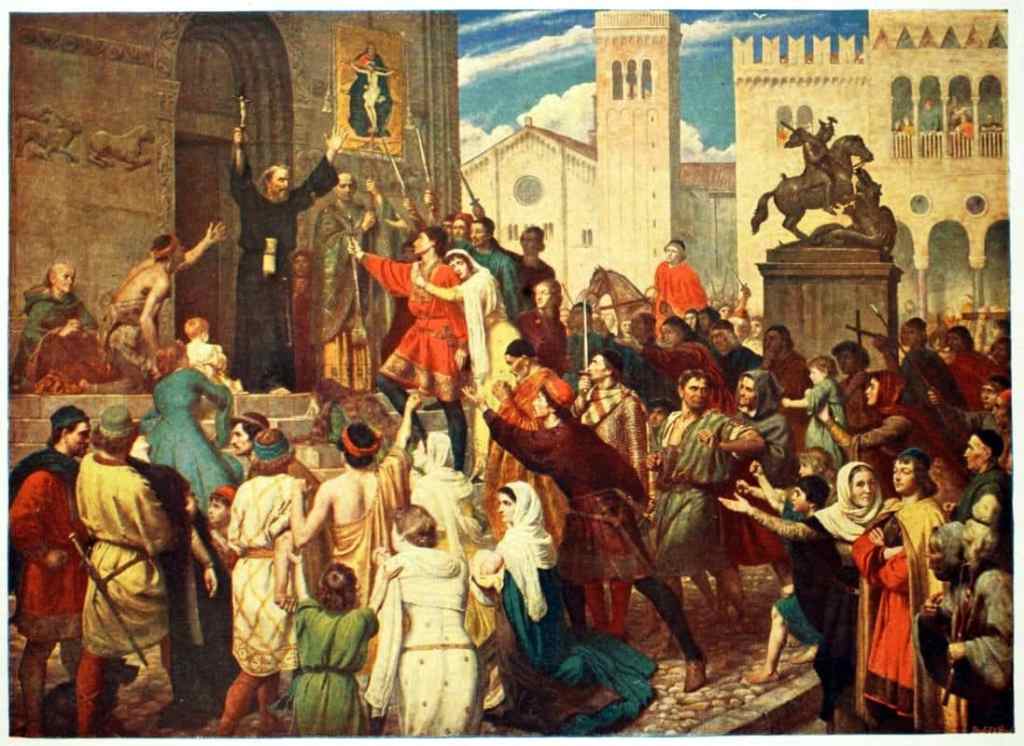
Moving from Clermont on to Tours, Le Mans and Auvergne where he preached the crusade to the local nobility, in his speech at the latter, Urban appealed to particular ethnic characteristics of the Franks about their martial practices very much in line with Galenic/Aristotelian climatic racial theories inherited from Antiquity, equally adhered to in the Islamic world, proclaiming “You are a nation originating from the temperate climes in the world, your readiness to shed blood leads to contempt for death though you are not without forethought and in the heat of battle you find room for reason”.The famous speech at Clermont by Pope Urban was meant to rouse the Franks specifically18, and aimed moreso at the bellatores19, the warriors, to undertake a pilgrimage to liberate Jerusalem. This would have also been the desire of the Eastern Roman Emperors, who had made specific calls for military aid. The historical reasons for appeal possibly had more to do with the prestige of recovering Anatolia, where the Komneni and their allied aristocratic networks had their origins. The disaster at Manzikert owed much to Andronicus Doukas and the Norman, Roussel de Ballieul’s withdrawal which left the Imperial Guard open to attack. Romanus Diogenes could set a rather balanced peace with Alp Arslan following the military defeat. However, it was Michael Doukas, his successor, who by having Romanus blinded, opened the floodgates. The resulting dissension from Eastern magnates allowed Roussel de Ballieul to carve his own dominion in Asia Minor, much as the Galatians of antiquity had. And his defeat only came at the hands of a Turkish Emir named Artuk who was invited by imperial authorities to deal with the Norman upstart. There was also the matter of the Armenian lords of Cilicia, who coalesced into a distinct Kingdom and nation over time, independent of Constantinople. At the beginning of the reign of Alexius Komnenos, his bother-in-law Melissenos also raised the flag of rebellion, and in order to bolster his armies, handed many western Anatolian cities, importantly Nicaea, over to Sulayman Qutalmish the Seljuk. Alexius may have well wished to play a diplomatic game, to have the Pope put a leash on the Normans, but to do his bidding, whilst not antagonising Kilji Arslan too greatly, to use him against the wishes of the Grand Seljuk in Baghdad. But the Crusader baron’s religious zeal and distaste for excessive flattery towards the Eastern emperor meant that Alexius merely ended up providing them free access across the Bosphorus, watching from Pelecanum and sending a mere 2000 infantry as assistance in the First Crusade’s second most important victory, the capture of Nicaea, under a loyal general, Tatikios. Alexius most likely sought the restoration of Imperial frontiers in Northern Syria with minimal commitment, hence the extraction of the oath from the great Crusading barons(a cause of discontent between leaders thereafter)20. The idea of a votive crusade would have been alien and unexplainable for the Byzantines. But to return to the bellatores, the transposition of the castellan system did bring many of this class to the Levant, with specific “crusading families” including not only the grandees such as the Hautevilles or the Embriaco of Genoa but also obscure names such as the de Bures, de Farquembuerges and D’Ibelins from France, all benefitting from the eastern acquisitions. The German disinterest(save for the Rhenish lands, as they were considered of the tribe of the Franks) in the first declared Crusade owed to the Antipapacy of Clement III backed by Heinrich IV21, but it wasn’t too long before German knights began participating as well. Urban declared that the Franks were a “just nation by the favour of the holy church” as the new tribe of Judah22. The exaltation was for the French nation to fight for the honour of their Church. Urban characterised this new campaign as an iter per remissionem peccatorum(a pilgrimage for the remission of sins). The biographer Ralph of Caen emphasises the descent of Godfrey of Bouillon from Charlemagne23, and lauded that a descendant now sat upon the throne of David in the Holy City. Going as far back to the Ludwigslied, a 9th century Old German poem dedicated to the character of Louis III of France for the victory over the Danes at Saunmur, showed the Vikings to be divine punishment for the sins of the Franks and as a test of faith of the victorious young King. These references are very specific and point back to a tradition of Frankish supercessionist political theology, namely the equivocation of Frankish Kings to David and the Franks to the Hebrews. The recorded anointment ceremony of Pepin the Short was modelled after that of the Kings of Israel. Recall the opening acclaim from Amalar of Metz’s laudes for the coronation of Louis the Pious, “Divo Hlodovico-Vita!, Novo David-Perennitas!”.24 The genius loci of Frankish kingship was Davidic25, in the perception of the Franks themselves. That Charlemagne was anointed thrice, once under his father, then with his brother Carloman and then as sole King as David had been in Scripture was not lost on the author of the Early Annals of Metz26. The Davidic parallel did not die out with the Carolingers, as we have many annals from the period of Capetians, Robert II and Louis VII referring to these Kings as Novus David27. The personification of the Crusader spirit, Louis IX, aimed to embody the synthesis between Priest and King in imitation of Christ and David through his rule. The famous procession for the internment of the Holy Crown of Thorns involved the gathered crowd in Paris shouting “Blessed is the One who comes in God’s name” (Lat.- Benedictus qui venit in nomine Domini from Mat.21:9). Gerard of St.Quentin did not fail to allude to the parallel of Christ’s entry into Jerusalem or to the deposition of the Ark of the Covenant by David in the Temple, referring to the King as “Notre David, roi Louis”.28 Even the imaginative embellishments of Robert the Monk could not cease from emphasising the special Frankish duty, having the Norman Bohemond de Hauteville declare in rage, “are we not Franks who liberated this land[Mezzogiorno]? Should we watch as our blood-brothers attain paradise without us?[in the Holy Land]”. Baldric de Berguil’s Historia has the same Bohemond appeal to his national pride at the crucial battle of Dorylaeum, “Yet to what undefeated nation(natio invictissima) has God granted the privilege of beating so many enemies?”.29 In another oration recorded by Baldric, Bohemond tells the crusaders ‘let us not be a reproach or a disgrace to all Christians’30, here, to be a Christian too, was to be part of a special gens31.
Along with the rise of the monastics in France, the Church was itself growing as an assertive power, backed and nourished by the new popular lay movements which demanded a change in the role of the Church. Arguably, Charlemagne and Louis the Pious sought to impose a form of Caesaropapist vision of Church reform, the latter directing the Visigothic monk Benedict of Ainane to regulate all orders in the Frankish Church according to the Benedictine Rule. This is obvious when one consults the Admonitio Generalis issued by Charlemagne in 789, meant to establish a common Roman custom of liturgy and sacraments. The royal monasteries at the time were after all, servitia regis(servants of the King). The division of Frankish power after the death of Louis left only one institution with the legitimacy to undertake wholesale reform, the institution which would thereafter argue that it had crowned Charlemagne. The spirit of the Rechtsverwirklichung(Realisation of Law) occurred hand in hand with the Papal Revolution. The Roman bishop was now both pastoral advisor and a defender of Petrine proprietary rights. Thereon the Amsrecht(decreed procedural law)corresponded to another arm of the law equal to volksrecht(folk-law). The tradition of medieval legal pluralism and the seed of the notion of separation of powers came with the differentiation between ecclesiastical and temporal political authorities. It should be said that the previously described expansion of castellan holdings, charter towns and the establishment of Roman law overseen by an aristocracy from the core of what was once a united Francia was not a phenomenon limited to the Levant, but was exercised in the expansions into Ireland and Brittany by the Normans all the same. Perhaps some degree of Eastern distinction came to be adopted in a forming self-conceptualisation as tota latinitas. The Patrimonium Petri would even attain some degree of real Imperium in the original Roman sense, via direct homage from the Norman duchies of Apulia and Sicily, Portugal and Aragon acknowledging themselves to be direct fiefs under the protection of the Papacy, often as a guarantee of their patrimonial independence. Hugh of St.Victor’s rubric, “All faithful of Christ by necessity are subject to the Roman Pontiff” was often in prefaced in copies of the corpus of canon law which included the bull Unam Sanctam claiming temporal subjection of the Kingdom of France by reason of the jurisdiction over sin. Latin Christendom was now not just a collection of kingdoms owing their formal obedience to the Roman Pontiff, but an estate society made up of strictly defined bishoprics covering Western and Central Europe borne from a Frankish nucleus. The libertas ecclesiae(freedom of the church) had to be paid for by a strengthening of the secular power of the Church itself, implying from the beginning the threat of considerable ‘worldliness’ in conflict with the Christian belief in the world to come. Concern about this worldliness found its most characteristic expression in the movements of the poor, for which the Church created a separate space for pure religious life, manifesting in the mendicant orders, which faced within themselves a battle as they confronted the world, producing radical spiritualists in search of a pure ecclesia spiritualis. And to top the contradiction with one within a contradiction, many radical spiritualists ended up allying with secular powers against the temporal Church.
Pope John X had personally led an army composed of Greeks and Lombards against a band of Muslim raiders in Lazio at the Battle of Garigliano. Pope Leo IX would do the same against the new wave of invaders, the Normans, arriving in Southern Italy. Leo was himself a Frank from Toul in Lorraine, a local centre of reformism, and a reformist agenda he pursued with great energy indeed. One of his successors, Nicholas II would reverse the papal stance against the Normans, thereafter becoming firm allies, and Alexander II became the first pope to bestow the vexillum sancti petri to Iberian soldiers as a mark of signifying papal approval. It was not only the profession of knights who were transformed by these radical changes, but the Church itself, the extension of the temporal authority of the Papacy birthed a new idea: regulation of war in bello et ad bello by a supranational authority, in simultaneity with other moral reformations. Banners of St.Peter were now regularly sent to those favoured by the Papacy32. The Normans who ventured into Sicily led by Roger de Hauteville would crush the Muslim forces at Cerami and Misilmeri under this same banner and sanction. The most famous instance of this dispensation was when William of Normandy invaded England with direct papal approval, as Alexander II had deemed Harold Godwinson an oathbreaker. In relation to earlier discussions on killing and penance, in 1070, a general penance was imposed(the Ermenfrid Ordinance) on all Normans who killed or maimed at Hastings, despite the legality of the war as a just public war. The Patarines of Milan and their leaders, Arialdo and Erlembald, were also shown papal favour as this peculiar popular revolt for clerical reform within the Archdiocese of Milan also took an anti-Imperial flavour. It may provide insight into the ecclesial links with rise of the commune, and associated campinilismo in Northern Italy. Additionally, the Pisans would launch a raid on Mahdia in Tunisia in 1087 backed by Matilda of Canossa and her benefactor, Pope Victor III, this event is now considered an important precursor to the formal crusades. The crusade as a personal prerogative of the Pope and it’s links to the ascendant papacy can be verified when one thinks of the obvious instance of the Albigensian Crusades against Dualist heretics in Occitania or the personal papal crusade against Ezzelino da Romano, a local tyrant from Lombardy, in 1254. Canon X of the First Lateran Council, and then Eugene III’s Bull, Quantum Predeccesores33 went as far as to place any Crusading noble’s territory to be under the direct protection of the Church, and absolved them of paying interest payments for their debts, in response to depredations and usurpations(common in a complex system overseen by mesne-lords and vavassours) seen in the two decades prior, as recorded in St. Ivo’s epistles. Great lords who returned from the Holy Land like Robert of Flanders faced external claimants, such as Emperor Henry IV, whereas Stephen-Henri of Blois had to contend with the petty lords infringing on his authority in his absence.
One obvious fascinating development of the Crusades were the Knightly Orders, of the Temple, the Hospital, and the Germans of the Hospital of St.Mary. Solemn vows were required to join all of them and the brothers expected to follow Order rules and follow the monastic horarium. The first, the Templars were originally confratres, a band of knights who had been given a tithe by Baldwin II of Jerusalem on the esplanade of the Temple Mount and later also evolved into the Order of the Holy Sepulchre. Taking vows of obedience, celibacy and obedience, they had influential early support from both Count Fulk V of Anjou(later King of Jerusalem) and St.Bernard of Clairvaux(far before the sermon at Vezelay). The latter influenced the gathering of clerics at the Council of Troyes, where the first proscriptions for military action by men under a clerical Rule were drafted, to be confirmed by Pope Innocent II’s charter, Omne Datum Optimum34. Templars in the 13th century would claim that Bernard was the actual founder of their order, the mastermind behind their Latin Rule, moreso than Hugues de Payens, hence their wearing of a cord in imitation of the Cistercians. The Templar Order was itself both a supranational organisation and breeding ground for incipient patriotisms. An impressive communication network based on the Order’s holdings, it’s banking power which propped up the French Crown in the 13th century and the development of patriotic divisions according to langues, were all factors that widened the appeal of the Order and contributed to it’s success. This was besides the cultivation of influence in royal households, famously such as that of Edward Longshanks. In the case of the Teutonic Knights, it should be noted that for a brief period following the fall of Acre in 1291, they were headquartered in Venice to focus on reclaiming a foothold in the Levant, before fully fixing their gaze on Lithuania propria from the already subdued region of Prussia35. They were preceded by the Livonian Sword-Brothers, mainly Cistercians/Templars, whose foundation had been justified in both defensive terms(defensio) and expansionary terms(dilatio) by Pope Innocent III when authorising the Livonian campaign in 1199. The Teutonic Order’s acquisition of power and it’s developed organisation into a Ritterschaft may have been in great part due to the indulgentis ordinis, which came to equated to an indulgence for the Reise36, the seasonal campaign of the Knights into pagan territory, with certificates being handed out for participating in the Pruwsscher Reisen no doubt playing a part in attracting knights from across Europe. A frank Frank, Jean le Meingre, sire de Boucicaut, admitted to journeying to Prussia thrice to enjoy the compaigneé des chevaliers as a test of valour, experiunde causa virtutis37, the love of fighting. But we should remember that the journey also involved the invoking of a votum, a religious oath, however much campaigning in Prussia became a matter of practical chivalry. Bohemian chronicler, Benes of Weitmil noted that the journey of warrior king John IV of Bohemia and Luxembourg in the winter of 1328-29 along with his great nobles to Prussia was “driven by the zeal of devotion”, all having taken the votum peregrinationis38.
Consulting the Gesta Francorum would tell any reader that the in French countryside, orally transmitted Gospel stories and tales of humility were widespread. Sacramental penitence has been a hallmark of Christian practice since Late Antiquity, and the canonical letters of the Cappadocian fathers list many sins for which the singular sacrament ought to be undertaken. However the Frankish tradition of penitence was deeply rooted in a communal folk-law sense of right and wrong, such that the highest form of perceived sanction, excommunication, was in theory the exclusion from an explicitly public body of the Church. Commutation by indulgence was a development from the weregild, akin to a bail paid by a kinsman. Atonement and restitution came to be conflated, as we find in multiple Frankish capitularies, the strict Gelasian division was for the most part, unfeasible and inapplicable. It should be noted that the Popular Crusade with Peter the Hermit at its head journeyed for the Holy Land before the Baronial coalition which represented the more formal Crusade did so. There was also the tendency for excessive apocalyptic urgency to overpower the pragmatic intentions of the seigneurial and ecclesiastical leaders, such as the Hermit’s scouring of the Rhineland. The knights who had taken the oath to go on Crusade referred to themselves as peregrini(pilgrims) and received alms in the villages to sustain them for their journeys. Of the first Genoese fleet, which set out in July 1097, a generation later, Caffaro di Rustico recounted in his De Liberatione Civitatum Orientis that “with the sermon having been completed and the apostolic message heard, many of the better Genoese that day took up the cross”39. The chroniclers gave the army of pilgrims many epithets, such as Christianorum congregatio or sanctum collegium. In France, the crusade itself came to be called via Dei. The strong emphasis on intentio recta in battle is evident in the speech of Genoese consul Gugliemo “Capotomallo(Hammerhead)” Embriaco to his fellow citizen-pilgrims before the city of Caesarea, “we entreat of you, under the debt of sacrament, that in the morning having made confession, you should make for the walls of the city without any delay”40. This same band of Genoese pilgrim-warriors were later accompanied by Baldwin I to the Holy Sepulchre during Easter in thanks for their reinforcement. Besides the singing of hymns, intercessory prayers and daily liturgies were also a common sight in these mobile pilgrim warrior-bands. Medieval views of penance through physical endurance even applied to those who drowned on the way from Messina to the Outremer. Not that the various interplay of beliefs did not produce contradictions. The brutality imposed on the populace of Jerusalem after it’s capture was acceptable according to a classical interpretation of the Saracens as hostes, as Urban’s speech at Clermont had classed them as. The violation of the right of asylum in the sack angered Tancred of Galilee, kinsman of Bohemond, according to the Gesta Francorum. In the true fashion of feodalite, different arrangements were made between the conquering knights and captured groups of Saracens, even within the same city. They were either allow to flee, convert or remain in safety. There was nothing considered contemptible in any of these arrangements, as long as the knight kept his word, and when this was not the case, the knight was not spared any rebuke. Furthermore, the punishment meted to the Saracens was seen as just retribution for the sacrilege of holy shrines and molestation of pilgrims, and for the Europeans of the time, sacrilege was more heinous a crime than murder. Raymond of Aguilers, chaplain to Raymond of Toulouse, who provided the goriest imagery of the Crusader entry into the city, “in the Temple of Solomon and the portico crusaders rode in blood to the knees and bridles of their horses”41, was evoking what was to him a striking parallel, to Revelations 14:20, “And the winepress was trodden without the city, and blood came out of the winepress, even unto the horse bridles”. This affirms the contemporary view that the struggles for the Holy Land were perceived as a renewal of the theophanic scriptural struggles, in the sense of an eternal repetition.
The military failure of the Crusades to consolidate in the Levant were not the end of the Crusading spirit by any means. In fact, the narrow aim of Jerusalem gave the first Crusade a motivating factor which sustained the fuel of the disciplined contingent which made it to the city, unlike the Crusades which followed it in 1101 and 114742. Later Portuguese exploration in Africa and Asia was conducted with a gaze transfixed upon the Holy Land as Axis Mundi. The sails of the caravels were adorned with the Cross of the Ordem de Cristo, a Portuguese splinter of the Templars, of which Henry the Navigator was Grandmaster and Da Gama, later in life, a knight. Alburquerque, from his string of Indian Ocean outposts, had designs on Egypt43. It should be noted that in Portugal, a Royal Board of Conscience(Mesa e Conscienca) was also instituted in 1532 as the highest court in the domain to deal with matters of moral theology and ecclesiastical affairs, playing a major role in the propagation of Portuguese power in the Ultramar. The campaigns of the Indian Ocean also produced a similar byproduct as the original Crusades in that upwardly mobile cadre of families, represented in high numbers in the Armadas, were incentivised to expand their holdings in the new territories. Over time, Crusading in the Mediterranean, whether pre-emptively or not became a matter of defending lands closer to home, with papal recognition for the Smyrniote and Savoyard crusades on minor targets alongside diplomatic achievements like the Holy Leagues culminating in great battles like Lepanto. Very close to home, the recruitment of the Duke of Mercoeur for the Austrian cause by St.Lorenzo of Brindisi and the subsequent Habsburg reconquest of Szekesfehervar and the great mystic’s charge at the gates of the fortress at the head of the army brandishing a crucifix alone re-enacted the fervour of the Crusades of old in many ways. Indeed the Habsburg campaign to recapture Hungary after the Siege of Vienna, in line with the Balkan crusades such as that of Varna and those led by Jan Hunyadi, may represent the apogee of the Crusading spirit in a real sense, before the onslaught of the age where the Reason of State and Balance of Power came to wholly subsume the affairs between European realms.
In such a time, David Hume, concerned foremost with the rational world of phenomena in custom and mores thought the First Crusade was “the most durable monument of human folly”.44 A romantic like Novalis on the other hand lauded the “resplendent times of Europe…this broad spiritual realm”.45 But speaking of rationalisation in general trends, where the “spheres” of nation and monarchy coincided, the conflict between Monarchy as a bureaucratic machina machinorum and the Church as it’s parallel bureaucratic counterpart reinforced the trend towards a restructuring of Christian political thought; towards its conversion into a community of international law made up of sovereign states. Just as it had spontaneously arisen and the fanned the flames, the Church quelched it’s own crusading fervour to adapt to the contingencies of the new times, where the ius publicum Europaeum regulated legitimacy of conflict from a view of self-neccesary defence of the body-politic as magni homini, the State as a great legal individual.

 The Mystagogue's Blog
Leave a comment